BHA & Ethoxyquin

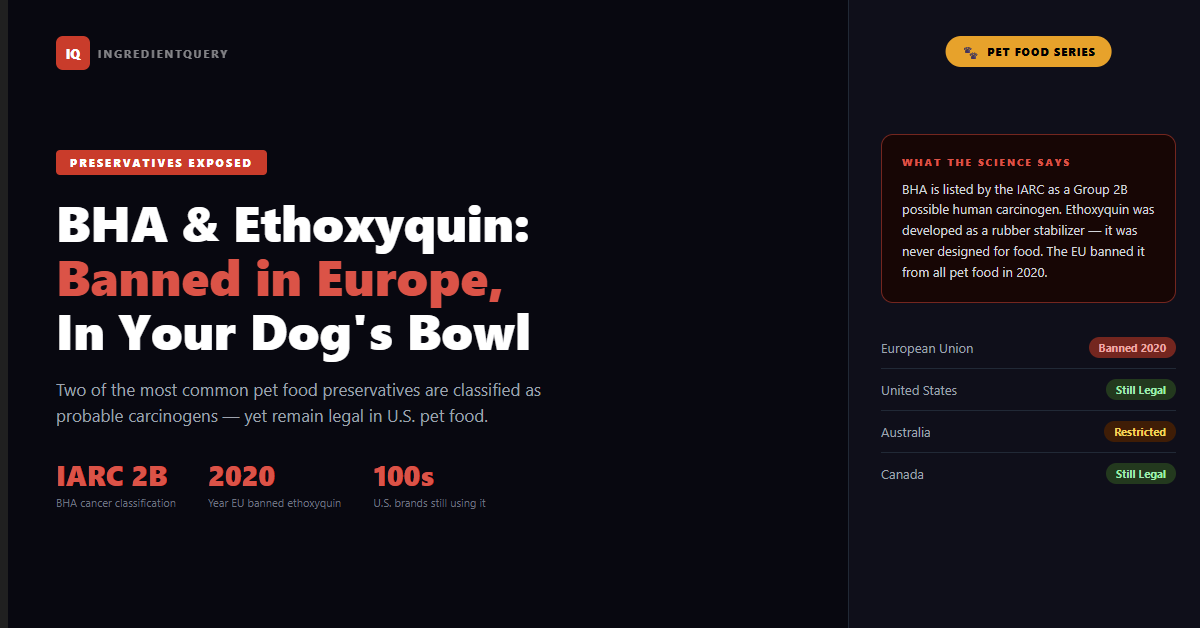
BHA and Ethoxyquin: Banned in Europe, Still in Your Dog's Bowl
In 2020, the European Union made a decision that barely registered in American pet food news: it permanently banned ethoxyquin from all pet food sold in EU member states. The reason — concerns about DNA damage, liver toxicity, and reproductive harm.
In the United States, ethoxyquin is still legal. It's still in pet food. And most dog owners have never heard of it.
What Is Ethoxyquin?
Ethoxyquin (chemical name: 1,2-dihydro-6-ethoxy-2,2,4-trimethylquinoline) was developed in the 1950s by Monsanto as an agricultural pesticide and rubber stabilizer. It was later approved by the FDA as a preservative for animal feed — specifically to prevent fish meal from oxidizing during long ocean transport.
That's the origin story most pet food companies don't advertise: your dog's food may contain a preservative that started its life as a rubber hardener.
It works extremely well as a preservative. It's also extremely cheap. That's why it stuck around in the U.S. pet food industry for 70 years.
What Does the Research Say?
The research on ethoxyquin has never been fully reassuring:
- A 1997 FDA Center for Veterinary Medicine report found elevated levels of a metabolite called ethoxyquin quinone imine in the blood of dogs fed ethoxyquin-containing food. The metabolite's toxicological profile was poorly understood — and still is.
- Studies in fish and poultry have linked ethoxyquin exposure to elevated liver enzymes, immune system disruption, and altered thyroid function.
- The EU's European Food Safety Authority (EFSA) conducted a comprehensive review in 2015 and 2019, concluding there was insufficient evidence that ethoxyquin is safe — and sufficient concern about genotoxicity (DNA damage) to justify a ban.
The FDA's response? In 1997, it asked pet food manufacturers to voluntarily reduce ethoxyquin levels. That voluntary request is still the current status. No mandatory limits have been updated since.
What Is BHA?
BHA (butylated hydroxyanisole) is a synthetic antioxidant used to prevent fats from going rancid. It's listed on the U.S. National Toxicology Program's Report on Carcinogens as "reasonably anticipated to be a human carcinogen." The International Agency for Research on Cancer (IARC) classifies it as Group 2B — a possible human carcinogen.
In California, BHA is listed under Proposition 65 as a chemical known to cause cancer.
It's also in dog food sold at every major U.S. retailer.
The confusing part: BHA is also approved for use in human food (cereals, chips, gum) at low levels. The FDA's position is that levels used in food are safe. Critics argue those safe thresholds were set decades ago, were never specifically tested in pets, and don't account for the fact that many dogs eat the same food — containing the same preservatives — every single day for their entire lives.
Cumulative lifetime exposure is a different calculation than a single meal.
Why Are They Still in U.S. Pet Food?
The short answer: regulatory lag and lobbying.
AAFCO (Association of American Feed Control Officials) sets the standards for pet food in the United States. AAFCO is not a federal regulatory agency — it's a voluntary membership organization of state and federal officials. It adopts ingredient definitions and has no enforcement authority. The FDA handles enforcement but rarely acts proactively on pet food ingredients.
The EU operates differently. EFSA's precautionary principle means ingredients must demonstrate safety — the burden of proof falls on manufacturers. In the U.S., the reverse is often true: ingredients remain approved until conclusively proven harmful.
The result: ethoxyquin was banned in the EU in 2020 based on the same research that has been publicly available in the U.S. for years. No U.S. ban has followed.
How to Spot Them on a Label
Direct listing: Look for "BHA," "BHT," or "ethoxyquin" in the ingredient list.
The fish meal loophole: Ethoxyquin is sometimes added to fish meal before it reaches the pet food manufacturer — meaning manufacturers can legally claim "no ethoxyquin added" even if the fish meal they purchased already contains it. If your pet food contains fish meal and doesn't explicitly state "ethoxyquin-free fish meal," it may be present even if not listed.
What to look for instead: Mixed tocopherols (a form of vitamin E), rosemary extract, and ascorbic acid (vitamin C) are natural preservatives used by premium brands. They're more expensive and have a shorter shelf life — which is exactly why budget brands don't use them.
Brands That Have Removed Them
Several major brands reformulated after consumer pressure:
- Purina phased out ethoxyquin from its dog food lines in the 1990s after consumer complaints
- Hill's Science Diet uses mixed tocopherols in most formulas
- Orijen / ACANA (Champion Petfoods) markets itself as ethoxyquin and BHA-free
- The Farmer's Dog, Nom Nom, and similar fresh/subscription brands use no synthetic preservatives by design — refrigeration and freeze-drying eliminate the need
The move away from synthetic preservatives is happening — just not fast enough, and not across the industry.
Scan Before You Buy
The fastest way to know what's in your pet's food: photograph the ingredient label with our Pet Food Scanner. It flags BHA, BHT, ethoxyquin, and 20+ other concerning ingredients in seconds — and explains exactly why each one matters.
Free. No account needed.
This article is for informational purposes only and does not constitute veterinary advice. Consult your veterinarian before changing your pet's diet.