The WHO Said Aspartame "Possibly Causes Cancer." The FDA Said Nothing Changed.

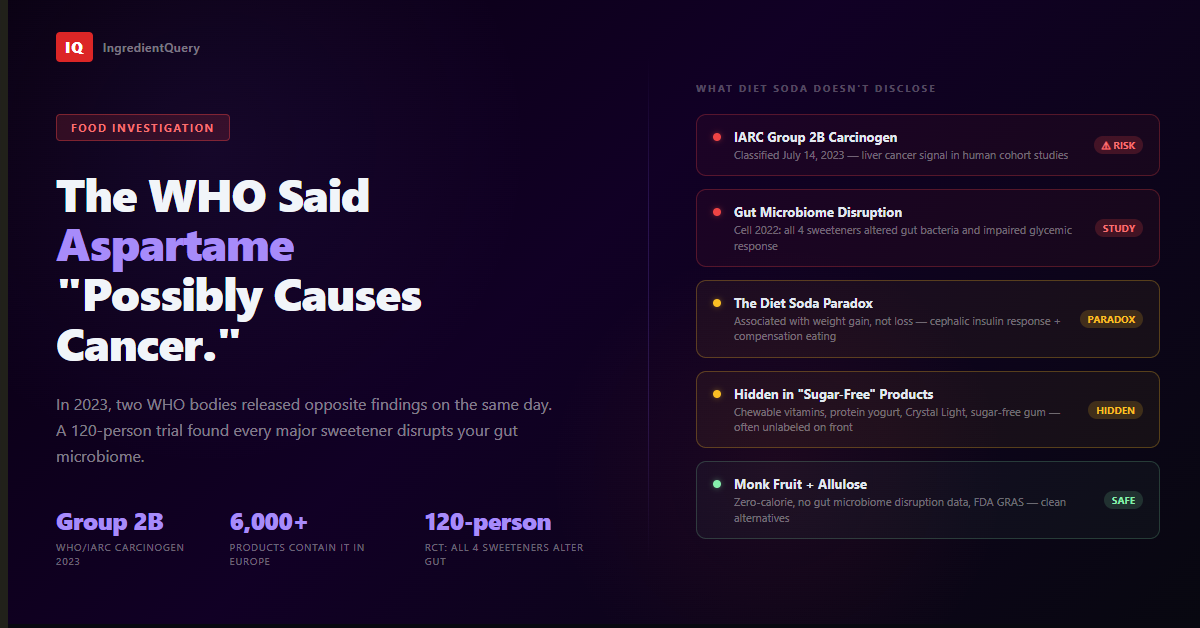
How two WHO bodies released opposite conclusions on the same day — and what a 120-person trial found about what sweeteners are doing to your gut.
On July 14, 2023, two different expert bodies within the World Health Organization released their findings on aspartame on the same day. They reached opposite conclusions.
One body — IARC, the WHO's cancer research arm — classified aspartame as a Group 2B carcinogen: "possibly carcinogenic to humans." The other body — JECFA, the WHO's food safety committee — concluded the evidence "is not convincing" and left the acceptable daily intake completely unchanged.
The simultaneous release of contradictory findings from the same international organization was, to put it mildly, unusual. And the confusion it produced was real.
What Aspartame Is
Aspartame was discovered by accident in 1965 and is approximately 200 times sweeter than table sugar by weight. It breaks down in digestion into phenylalanine (50%), aspartic acid (40%), and methanol (10%).
The FDA approved aspartame in 1981 — after a Public Board of Inquiry in 1980 had actually recommended against approval, citing animal brain tumor findings. It reached carbonated beverages in 1983 under the brand name NutraSweet, then Equal. By 1984, aspartame was a $600 million annual business.
Today it appears in over 6,000 products in Europe alone.
Why Two WHO Bodies Reached Opposite Conclusions on the Same Day
IARC conducts hazard identification — it asks whether a substance can cause cancer under any conditions, without assigning risk levels for typical exposures.
JECFA conducts risk assessment — it determines what the probability of harm is at realistic human exposure doses.
JECFA's conclusion: a can of Diet Coke contains roughly 185 mg of aspartame. An adult weighing 68 kg would need to drink approximately 9 to 14 cans of diet soda per day to reach JECFA's ADI of 40 mg/kg. Below that threshold, the evidence doesn't support a cancer risk.
IARC is saying: the signal exists. JECFA is saying: at real-world doses, the signal isn't strong enough to change anything.
Where Aspartame Hides
Any product labeled "sugar-free," "zero sugar," "light," or "diet" is a candidate. On labels it appears as aspartame (US) or E951 (Europe).
- Diet sodas: Diet Coke, Pepsi Zero Sugar, Sprite Zero, Diet Dr Pepper, Diet Snapple
- Sugar-free gum: Mentos, Extra, Orbit, Trident
- "Light" yogurts: Yoplait Light, Dannon Activia Light, Weight Watchers branded products
- Crystal Light and flavored water packets
- Chewable vitamins and medications: children's multivitamins, chewable antacids, OTC pain relievers
- Protein powders: many "zero sugar" flavored varieties
- Sugar-free condiments and syrups: Torani sugar-free syrups, "diet" salad dressings
What a 120-Person Trial Found About Your Gut
A randomized controlled trial published in Cell in September 2022 enrolled 120 healthy adults who had not previously consumed artificial sweeteners. Participants were assigned for two weeks to: saccharin, sucralose, aspartame, stevia, glucose, or no supplement.
All four tested artificial sweeteners — saccharin, sucralose, aspartame, and stevia — distinctly altered both the stool microbiome and oral microbiome, as well as the plasma metabolome.
Saccharin and sucralose caused the most significant glycemic disruption. The researchers confirmed causation by transplanting altered microbiome samples into germ-free mice — the mice reproduced the same glycemic impairments.
The Diet Soda Paradox
If artificial sweeteners have no calories, why do studies consistently associate diet soda with weight gain rather than weight loss?
- Cephalic phase insulin response: sweetness triggers preemptive insulin release without glucose arriving — potentially contributing to fat storage over time
- Blunted satiety signals: without real calories arriving in the gut, satiety hormones may not fully fire, increasing appetite
- Behavioral compensation: people who consume zero-calorie products tend to "offset" the savings with higher-calorie food elsewhere
The Other Sweeteners
Sucralose (Splenda) — A 2023 study in the Journal of Toxicology and Environmental Health B found that sucralose-6-acetate — produced during digestion — is genotoxic in vitro. Exposed gut cells showed increased activity in genes related to oxidative stress, inflammation, and carcinogenicity. The Cell 2022 study found sucralose caused the most significant glycemic disruption of any tested sweetener.
Saccharin (Sweet'N Low) — The Cell 2022 study found saccharin significantly impaired glycemic response through microbiome disruption.
Acesulfame potassium (Ace-K) — A 2022 prospective cohort study (NutriNet-Santé) found Ace-K was associated with higher coronary artery disease risk.
What to Use Instead
Monk fruit — 100 to 250 times sweeter than sugar, zero calories, FDA GRAS since 2010, no adverse effects found, heat-stable for baking.
Allulose — only 0.2 to 0.4 calories per gram, FDA doesn't count it as "added sugar," human studies show reduced post-meal blood glucose and insulin response.
Stevia (high-purity extract only) — FDA GRAS; note the Cell 2022 study found it also altered gut microbiome composition.
The Bottom Line
The Cell study added something the WHO debate didn't address: even below safety thresholds, artificial sweeteners are not biologically inert. They alter the gut microbiome. They disrupt glycemic response. The effects appear across all four major categories of sweetener.
The products designed to avoid the health consequences of excess sugar may be delivering their own set of consequences through the compounds used to replace it.
Monk fruit and allulose exist. They work. The technology for making sweet food without synthetic chemistry is already here.
Scan any ingredient label at ingredientquery.com to identify aspartame, sucralose, acesulfame potassium, and other artificial sweeteners across product categories.