They're Putting Lead in Your Turmeric. On Purpose.

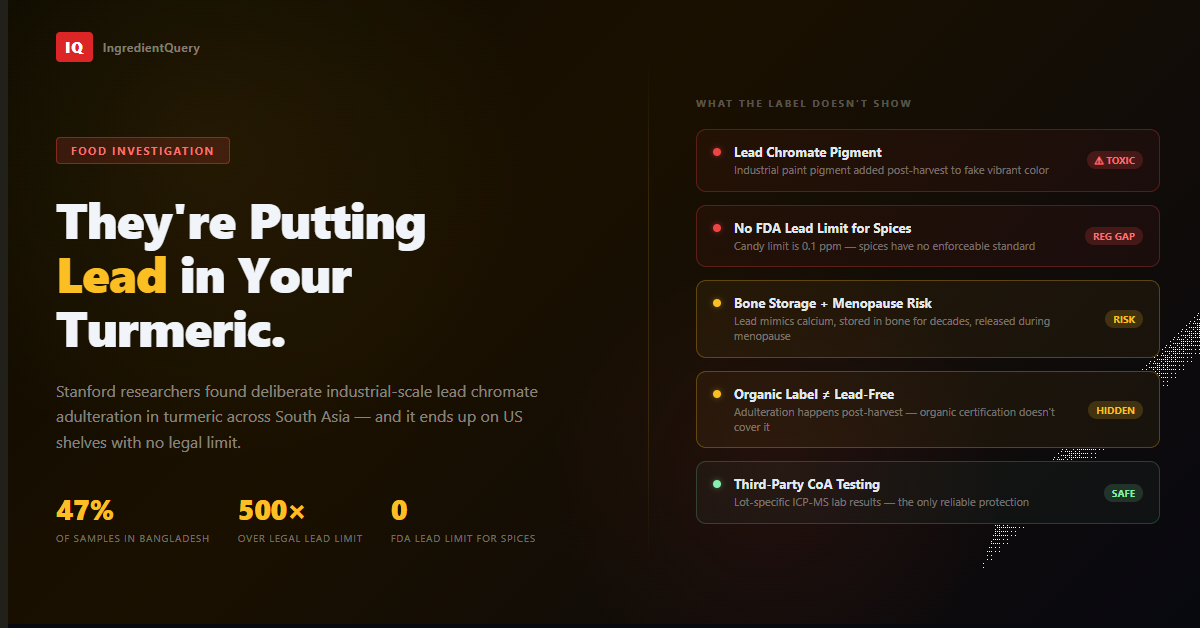
What Stanford researchers found inside one of the world's most popular health supplements — and why the FDA still hasn't set a legal limit.
What if the supplement you've been taking every morning to reduce inflammation was quietly raising your blood lead levels?
That's not a hypothetical. Researchers from Stanford University spent years documenting a deliberate, industrial-scale practice of adding lead — specifically lead chromate, an industrial orange-yellow pigment — directly to turmeric powder after harvest. Not as an accident. Not as a trace contaminant. As a business decision.
And Consumer Reports found that roughly one-third of 126 spice products tested in the US had heavy metal levels high enough to raise health concerns. Turmeric was among the worst offenders.
Here's the full story.
Why Anyone Would Put Lead in Turmeric
Turmeric starts out vibrant. Fresh turmeric root has a deep, saturated orange-yellow color — the same color that makes golden milk look golden and curry look rich. But after the roots are harvested and dried, that color fades. The powder becomes pale, dull, almost muddy.
Buyers pay a premium for bright, saturated turmeric. In wholesale markets across South Asia, vivid yellow powder commands higher prices because it looks fresher, more potent, more valuable.
Lead chromate — chrome yellow, an industrial pigment historically used in paint — solves this problem cheaply. It is intensely yellow-orange, shelf-stable, and inexpensive. A small amount dusted onto dried turmeric roots during polishing transforms dull, pale powder into something that looks premium.
And it contains approximately 64% lead by weight.
What Stanford Found
Between 2017 and 2019, researcher Jenna Forsyth and a team from Stanford's Emmett Interdisciplinary Program in Environment and Resources conducted extensive field work in Bangladesh — one of the world's largest turmeric producers and exporters.
What they found was systematic.
At processing mills, workers were applying lead chromate pigments to turmeric roots as part of routine polishing. The practice had been going on for more than 30 years. Lead concentrations in contaminated samples reached a maximum of 1,152 micrograms per gram — roughly 500 times Bangladesh's own legal limit. Soil at the processing mills registered over 4,000 μg/g of lead.
In 2019, 47% of turmeric samples from Bangladeshi markets tested positive for lead chromate contamination.
The Stanford team's 2024 follow-up study expanded the scope: 356 turmeric samples from wholesale and retail markets across 23 cities in India, Pakistan, Sri Lanka, and Nepal. Fourteen percent had detectable lead above safe thresholds. In some cities — Patna in Bihar, Karachi, Peshawar — samples again reached over 1,000 μg/g. The researchers projected that children consuming turmeric from the most contaminated sources in these cities could have blood lead levels up to 10 times the CDC's threshold of concern.
This wasn't a regional anomaly. It was a supply chain problem that followed the turmeric wherever it went — including to US store shelves.
It's Here in America Too
A 2017 study published in Public Health Reports found that lead in turmeric sampled from Boston grocery stores ranged from 60 to 530 times the FDA lead standard for comparable food products.
A New York City health department analysis found detectable lead in nearly half of approximately 1,500 turmeric samples purchased in the US between 2008 and 2017.
The CDC documented a childhood lead poisoning cluster in Las Vegas in 2019 traced directly to turmeric from the family's kitchen.
In Seattle, four separate cases of elevated childhood blood lead levels were traced to turmeric in the home — cases that public health investigators noted only came to light because someone thought to test the spices.
In 2021, Consumer Reports tested 126 herbs and spice products from 38 brands. One-third had heavy metal levels high enough to raise concern for children consuming typical serving sizes. Among turmeric specifically, La Flor Ground Turmeric landed in the "high concern" category — the only turmeric product at that severity level.
Even brands in the "better" category — including McCormick, Kirkland Signature (Costco), and Morton & Bassett — showed measurable lead.
The FDA Has No Legal Limit for Lead in Spices
This is perhaps the most staggering regulatory gap in the US food safety system.
The FDA has a maximum allowable lead level of 0.1 parts per million for candy frequently consumed by children. They have standards for bottled water (0.005 ppm), juice (10 ppb for children's juice). There is no established maximum lead limit for spices — including turmeric — in the United States.
The FDA has issued more than a dozen import alerts for specific turmeric products from South Asian companies found to have elevated lead. The 2016 FDA recall of Gel Spice products — including turmeric sold under the Fresh Finds, Market Pantry, Spice Select, and Lieber's brands — showed the agency can act. It recalled products from Archer Farms (Target's house brand) and Spice Hunter in 2011.
But there is still no binding limit. No systematic testing requirement. No mandatory disclosure. Companies are expected to self-police using voluntary industry guidelines that are not enforceable.
Why This Especially Matters for Women
Here's where the science hits on something most people don't know — and it's backed by serious research.
Lead behaves like calcium in the body. The two elements have nearly identical ionic radii, which means lead can exploit every biological pathway the body built to handle calcium. It enters bones through the same channels calcium does. It embeds in bone tissue, sitting dormant in the mineral lattice — and it stays there for decades. Scientists estimate cortical bone has a lead half-life of 10 to 28 years.
At any given time, 90 to 95% of the lead in your body is in your bones.
This would be less alarming if lead just stayed there. But it doesn't.
When bone breaks down — during normal aging, calcium deficiency, pregnancy, or menopause — the lead stored in bone tissue gets released back into the bloodstream along with the calcium it was mimicking.
A landmark study published in Environmental Health Perspectives followed women undergoing surgical menopause. Their blood lead levels increased measurably within six months. Women not using hormone replacement therapy showed even larger increases. A separate NHANES study of nearly 3,000 women found postmenopausal women had blood lead levels significantly higher than premenopausal women — and those levels correlated directly with markers of bone turnover.
The lead doesn't disappear after menopause. It circulates. It reaches the kidneys, the cardiovascular system, the brain — organs that face their own set of age-related challenges. A 2024 study in Environmental Research found that bone lead burden predicts cardiovascular mortality at nearly double the rate that blood lead tests alone would suggest, pointing to a massive underestimation of lead's long-term risk.
The implications for turmeric are direct: this is a supplement heavily marketed to middle-aged and older women, taken daily for years, sourced from a supply chain with documented industrial-scale lead adulteration and no regulatory lead limit.
Lead Has No Safe Level
The CDC states explicitly: there is no established safe blood lead level. That's not rhetoric — it reflects decades of research showing that even low-level lead exposure causes measurable, irreversible harm.
At blood lead levels below 5 μg/dL — levels well within what many Americans carry — research documents IQ decrements in children, increased cardiovascular mortality in adults, and impaired kidney function. A landmark 2018 study published in The Lancet Public Health estimated that low-level lead exposure accounts for 412,000 premature deaths per year in the United States, with cardiovascular disease driving most of that toll.
The chromium in lead chromate adds a separate concern: hexavalent chromium is classified by the WHO's International Agency for Research on Cancer as a Group 1 carcinogen — meaning it definitely causes cancer in humans, specifically lung and kidney cancer.
So when lead chromate enters your turmeric, you're not getting just lead. You're getting lead and a confirmed human carcinogen in the same compound.
Does Organic Protect You? Not Necessarily.
This is where many health-conscious consumers get blindsided.
USDA Organic certification governs farming practices — what goes on the soil, what pesticides are used, whether the crop is genetically modified. It does not cover what happens at the processing facility after harvest.
Lead chromate adulteration happens at the post-harvest processing stage — during polishing, drying, and milling. An organically grown turmeric root can be polished with lead chromate and still carry an "organic" label on the final product, because the organic standard was met at the farm level.
Researchers confirmed this directly. A 2017 study sampling Boston grocery stores found no statistically protective effect from organic certification on turmeric lead levels. A 2023 study in Douglas County, Nebraska found lead in spices including organic brands.
What actually protects you: lot-specific, third-party heavy metal testing of the finished product, with results published as a Certificate of Analysis (CoA). This is different from organic certification and far more relevant to lead risk.
Which Brands Are Safer — and Which Have Failed
Brands with documented lead problems:
- La Flor Ground Turmeric — "High concern" in Consumer Reports 2021
- Gel Spice brands (Fresh Finds, Market Pantry, Spice Select, Clear Value, Lieber's) — FDA recall 2016
- Archer Farms (Target) — Recalled 2011
- Spice Hunter — Recalled 2011
- Pran brand (Bangladesh) — 28–53 ppm lead detected; FDA import alert issued
Brands rated "Best" in Consumer Reports / Mamavation analysis:
- Simply Organic Turmeric
- Spice Islands Turmeric
- Laxmi Brand Turmeric Powder
- Sadaf Turmeric Powder
- Badia Ground Turmeric
Important caveat: Even "best" brands can vary between production lots. A brand that tested clean in one analysis may not be clean in every batch. The only true protection is lot-specific lab results.
What to Do
When buying turmeric powder or supplements:
- Look for brands that publish lot-specific Certificate of Analysis (CoA) results from independent labs
- Choose products with NSF International, USP Verified, or ConsumerLab certification — these test the finished product for heavy metals
- "Organic" alone is not sufficient — combine with third-party metal testing
- Avoid brands under FDA import alert: Pran, Visakarega Trading, IndoVedic Nutrients
- Unusually bright, saturated orange-yellow color can be a warning sign of lead chromate addition
Practical home screening test: Mix a small amount of turmeric powder with concentrated hydrochloric acid (muriatic acid, available at hardware stores). Adulterated turmeric turns magenta or red. Pure turmeric does not. Not quantitative, but it flags obvious adulteration.
What IngredientQuery Flags
When a product lists turmeric as an ingredient, IngredientQuery flags it for heavy metal contamination risk — particularly when sourcing is unspecified and no third-party testing data is available from the brand.
Turmeric itself isn't the problem. The root, grown and processed cleanly, is a legitimate functional ingredient with real anti-inflammatory properties. It's flagged because the supply chain has a documented industrial contamination problem that regulatory agencies have not addressed with binding limits — and because the health effects of lead exposure don't appear on any ingredient label.
The Bottom Line
Turmeric is real food with real benefits. This isn't a reason to stop using it. It's a reason to buy it from brands that test it.
A supplement that's supposed to reduce chronic inflammation shouldn't come with a side of lead that accumulates in your bones over years — lead that your own skeleton releases back into your blood during menopause, with no FDA limit to protect you.
You're spending money on your health. Make sure the turmeric you're buying has been tested by someone whose job it is to look for lead.
Paste any ingredient label into ingredientquery.com to scan for flagged additives, heavy metal risk, and processing concerns.